Broken English, Unbroken Reach: Why the Accent Is the Brand Now
There used to be an unspoken rulebook. If you wanted to make it on American screens — big, small, or glowing in someone's palm at 2 a.m. — you smoothed things out. You softened the rolled R's, buried the clipped consonants, and learned to sound like you came from a place that technically doesn't exist: Neutral American Media Land. That was the deal.
Somebody forgot to send Gen Z the memo.
The Algorithm Doesn't Care About Your Elocution Lessons
Right now, some of the most-watched creators on TikTok and YouTube sound nothing like the anchors your parents grew up watching. They speak in thick Eastern European cadences, in the warm lilt of Nigerian English, in the rapid-fire rhythm of South Asian speech patterns that compress syllables in ways American tongues simply don't. And their comment sections? Absolutely on fire — in the best way.
What's happening isn't an accident. It's a structural shift in how authenticity gets coded online. When every major media company spent decades scrubbing accent out of the picture, it created a vacuum. And into that vacuum walked a Polish girl explaining skincare routines with deadpan precision, a Ghanaian guy breaking down geopolitics with the cadence of someone who grew up hearing three languages before breakfast, and a Tamil creator whose commentary on American fast food somehow landed funnier than anything scripted in a Hollywood writers' room.
The accent stopped being the obstacle. It became the whole point.
Why It Hits Different
There's a psychological mechanism at work here that's worth naming. Psychologists who study parasocial relationships — the one-sided bonds audiences form with media personalities — have long noted that perceived authenticity is the engine of connection. When someone sounds "produced," the brain registers it, even subconsciously. There's distance. A polish that reads as performance.
But when a creator stumbles over a phrase, laughs at their own phrasing, or casually code-switches mid-sentence into their first language before catching themselves? That's a crack in the wall. And cracks are where connection gets in.
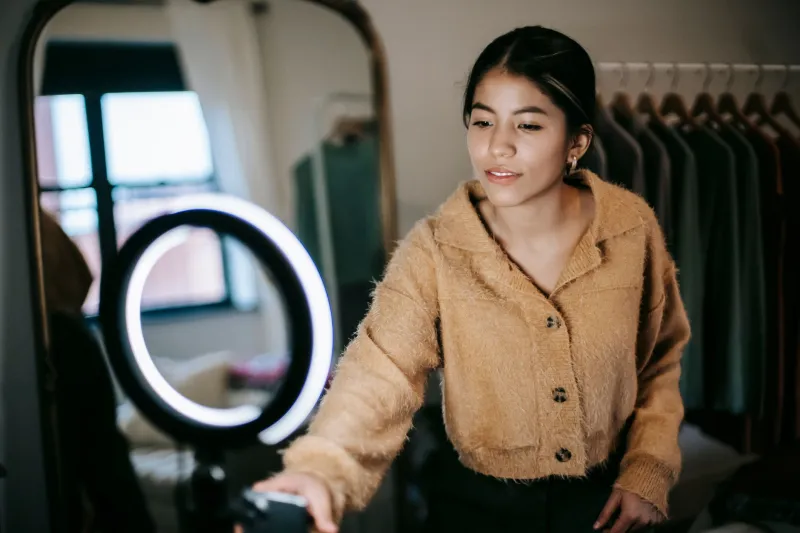
Gen Z grew up watching influencer culture metastasize into something increasingly artificial. The ring lights got brighter, the edits got tighter, the brand deals got more obvious. So when a creator shows up sounding like an actual person from an actual place on the actual planet Earth, it registers as radical honesty. The accent signals: I am not performing for you. This is just how I sound.
That's a powerful thing to communicate without saying it.
Eastern Europe Is Having a Moment (Several, Actually)
If you've spent any time on TikTok's For You page in the last two years, you've probably encountered the particular flavor of deadpan that Eastern European creators have turned into a genre unto itself. The flat delivery. The refusal to oversell a joke. The way something absolutely absurd gets stated with the calm of a person reading a grocery list.
American audiences, raised on the enthusiasm of morning show hosts and the hyperbolic energy of early YouTube, found this genuinely disorienting at first — and then completely addicting. Creators from Romania, Poland, Ukraine, and Russia (pre-algorithmic complications, anyway) built massive followings partly because their presentation style was so foreign to what American content had trained people to expect.
The accent wasn't just flavor. It was the entire comedic architecture.
South Asian Creators and the Reclamation Project
For South Asian Americans, this moment carries additional weight. For years, the Indian accent was one of American comedy's cheapest punching bags — a lazy shorthand for a certain kind of otherness that TV writers reached for when they needed a quick laugh and didn't want to think too hard.
The generation of South Asian creators now dominating YouTube commentary, educational content, and lifestyle spaces isn't ignoring that history. They're actively writing over it. Creators who speak with accents rooted in Mumbai, Chennai, or Lahore aren't softening those sounds for an American audience — they're leaning in, and their audiences are following.
What's particularly striking is who those audiences are. It's not just diaspora communities finding mirrors of themselves online, though that matters enormously. It's also white kids in Ohio and Black teenagers in Atlanta and everyone in between, subscribing and sharing and quoting these creators back to each other. The accent became aspirational in a way that would have seemed genuinely impossible twenty years ago.
African Voices and the Authenticity Premium
Nigerian, Kenyan, and South African creators have carved out some of the most distinctive spaces in the current content landscape. There's a confidence and directness in a lot of West African English — a rhetorical style that doesn't hedge, doesn't apologize, and doesn't wait for permission — that translates extraordinarily well to short-form video.
Creators from Lagos in particular have built followings that cross every demographic line imaginable. Their commentary on American culture, delivered with the particular clarity that comes from observing something from the outside, tends to land with a precision that purely domestic creators sometimes miss. There's a reason "Nigerians react to" has become its own genre.
The accent in these cases is inseparable from the perspective. You can't have one without the other, and audiences seem to understand that intuitively.
What the Media Industry Still Hasn't Figured Out
Here's where it gets complicated. Traditional media — legacy YouTube channels, streaming platforms making their own creator content, even some podcast networks — has started noticing these numbers and trying to replicate the formula. The results are frequently awkward.
You can't manufacture the thing that makes these creators work. Signing a creator with an accent and then coaching them on their delivery, or editing around their natural speech patterns to make it "cleaner" for a broader audience, is exactly the kind of move that destroys the value proposition. The audiences who showed up for the unfiltered version know immediately when something has been processed.
The lesson for anyone paying attention: the accent isn't a feature you can add. It's evidence of a life lived somewhere specific, in a particular way, with a particular set of experiences informing every sentence. The reach comes from the realness, and the realness isn't transferable.
The Longer Arc
What's unfolding right now on TikTok and YouTube is part of something bigger than content strategy. It's a renegotiation of whose voice gets to sound authoritative, whose delivery gets to be considered polished, and whose way of speaking gets to be treated as the default rather than the exception.
For a very long time, American media answered all three of those questions the same way. The answers are changing. And the proof is in the view counts.